
Blog
Maryland’s Population Challenge: Maryland Is Losing People to Other States and Why It Matters
Dec 18, 2025
Key Takeaways: Maryland's Tax Climate
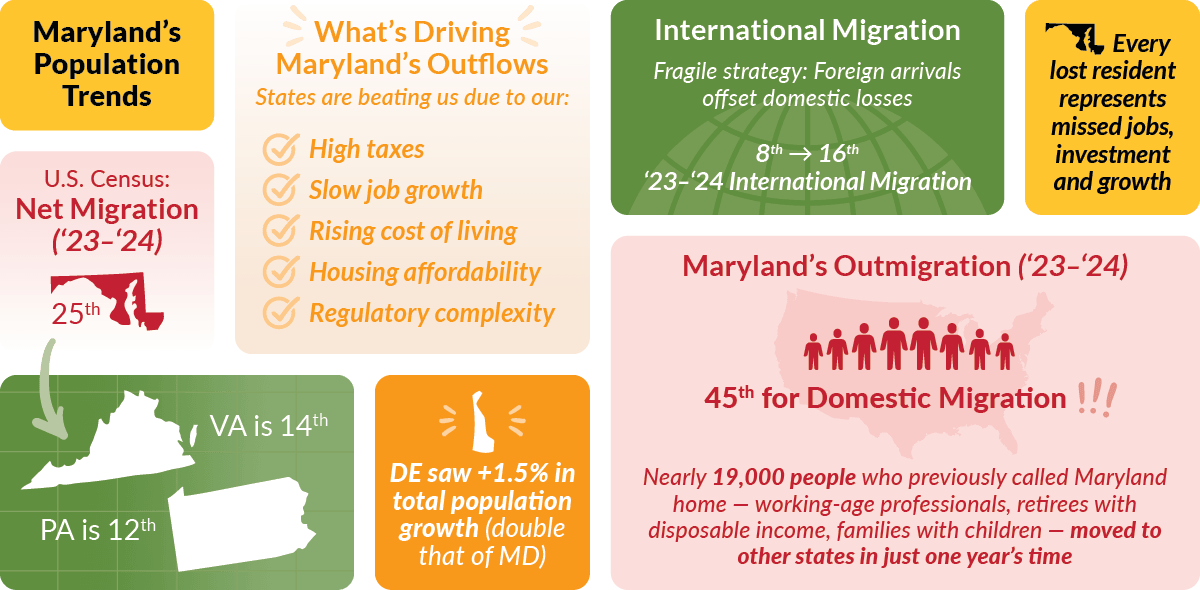
- Maryland’s Population Drain: The state has lost 18,509 residents to other states in just one year (July 2023–July 2024), ranking 45th nationally in domestic migration. Growth comes mainly from +53,100 international arrivals, masking domestic losses. Long-term (2020–2024), Maryland lost 120,435 residents to other states, ranking 44th nationally.
- What’s Driving It: High taxes, rising living costs, housing affordability challenges and regulatory complexity are pushing residents to states with lower costs, better growth prospects, and more business-friendly climates.
Who's Leaving and Why It Matters
Imagine deciding where to build your career or expand your business. You want good jobs, affordable housing and a thriving community. Increasingly, Maryland struggles to deliver on all three.
Maryland ranks 45th in the nation for domestic migration, a troubling signal for a state that urgently needs stronger momentum in talent, jobs and economic growth.
A recent report from the Maryland Comptroller rightly raises alarm about out-migration and highlights housing affordability as a major concern. That warning is important — but housing alone doesn’t explain why people and businesses are leaving Maryland. Our insights show that slower job growth, rising costs and limited economic opportunity are playing a larger role — and shaping housing affordability itself.
Governor Moore’s focus on housing supply and permitting reform is a positive and necessary step. To truly reverse the trend, these efforts must be paired with policies that restore economic momentum and expand opportunity.
The Numbers Tell the Story
From July 2023 to July 2024:
- Maryland added just 46,158 people (+0.7% growth, 24th nationally).
- But that growth masks a deeper issue: 18,509 residents left for other states — ranking Maryland 45th in domestic migration.
- We only grew because 53,100 international arrivals offset domestic losses.
Over a longer horizon (2020–2024), Maryland lost 120,435 residents to other U.S. states, highlighting a persistent talent drain that threatens businesses, communities, and taxpayers alike.
What that means: Nearly 19,000 people who previously called Maryland home — working-age professionals, retirees with disposable income, families with kids — moved elsewhere. These aren't random moves. They're calculated decisions based on jobs, taxes, housing costs and quality of life. And increasingly, Maryland is losing in that calculation.
Why Population Trends Matter
Population shifts aren’t just numbers — they affect the economy, workforce and tax base.
- Businesses: Smaller talent pools, fewer customers and slower growth.
- Workers: Limited opportunities and rising costs push more people to leave.
- Taxpayers: Maintaining schools, roads and public services becomes harder with slower population growth.
What’s Driving the Outflow
Residents and businesses are moving to states that offer:
- Lower taxes and reduced cost of living
- Greater housing affordability
- Better private-sector job growth and career opportunities
- Streamlined regulations that support business expansion
Housing affordability is a symptom of deeper economic pressures: without jobs, opportunity and a sustainable cost structure, housing alone cannot retain Maryland residents.
The Regional Reality: Maryland vs. Its Neighbors
Let’s look at Maryland’s population performance two ways — looking at data from both the most recent year and with a multi year view (2020–2024):
*Ranks are national (1 = strongest/fastest; 50 = weakest/slowest)
Table 1: Population & Migration (U.S. Census, July 2023–July 2024)
| MD '21 | MD '22 | MD '23 | MD '24 | VA '24 | PA '24 | DE '24 | WV '24 | Best | |
| State Population | 19 | 19 | 19 | ↑18 | 12 | 5 | 45 | 39 | California |
| Population Change | 40 | 43 | 24 | ↑ 21 | 12 | 15 | 36 | 50 | Texas |
| Population Change Percent | 38 | 40 | 32 | ↑ 24 | 19 | 41 | 8 | 49 | Florida |
| Total Net Migration | -- | 42 | 42 | ≡ 25 | 14 | 12 | 44 | 41 | Florida |
| Net Domestic Migration | 44 | 44 | 46 | ↓ 45 | 20 | 43 | 14 | 22 | Texas |
| Net International Migration | 12 | 14 | 8 | ↓ 16 | 15 | 8 | 39 | 46 | Florida |
Table 1.2: Population & Migration (U.S. Census, July 2020–July 2024)
| MD '23 | MD '24 | VA '24 | PA '24 | DE '24 | WV '24 | Best | |
| Population Change | 33 | ↑ 23 | 12 | 25 | 28 | 47 | Texas |
| Population Percent Growth | 34 | ≡ 34 | 26 | 42 | 6 | 50 | Florida |
| Net Total Migration | 45 | ↑ 33 | 17 | 11 | 27 | 40 | Florida |
| Domestic Migration | 45 | ↑ 44 | 38 | 41 | 16 | 23 | Florida |
| International Migration | 12 | ↓ 16 | 15 | 9 | 41 | 46 | Florida |
Table 2: Why Population Trends Matter for Competitiveness
| MD '22, '23, '24 | MD '25 | MD Δ | VA '25 | VA Δ | PA '25 | PA Δ | DE '25 | DE Δ | WV '25 | WV Δ | Best | |
| Population Change (Headcount) | 40, 43, 24 | 21 | +46,158 | 12 | +76,510 | 15 | +61,030 | 36 | +15,494 | 50 | -516 | Texas |
| Population % Growth | 38, 40, 32 | 24 | +0.7% | 19 | +0.9% | 41 | +0.5% | 8 | +1.5% | 49 | ~0% | Florida |
| Total Net Migration | 42 | 25 | +34,591 | 14 | +61,439 | 12 | +70,601 | 34 | +15,438 | 41 | +7,361 | Florida |
| Net Domestic Migration | 44, 44, 46 | 45 | -18,509 | 20 | +5,284 | 43 | -11,500 | 14 | +8,155 | 22 | +4,520 | Texas |
| Net International Migration | 12, 14, 8 | 16 | +53,100 | 15 | +56,155 | 8 | +82,101 | 39 | +7,283 | 46 | +2,841 | Florida |
Maryland’s domestic outflow stands out compared with nearby states:
- Virginia: +76,510 (+0.9% growth), small domestic inflow (+5,284)
- Delaware: +15,494 (+1.5%), domestic inflow (+8,155)
- Pennsylvania: +61,030 (+0.5%), domestic outflow (–11,500)
- West Virginia: +6,282 (~+0.4%), modest domestic gain
Takeaway: Maryland’s overall growth depends on international arrivals offsetting domestic losses — a fragile strategy for long-term competitiveness.
States that attract residents and businesses aren’t leaving it to chance: Florida, Texas and the Carolinas leverage tax-friendly policies, regulatory streamlining and strategic workforce investments to retain and attract talent. Maryland must learn from these examples.
Table 3: 2020–2024 Cumulative Snapshot
| MD ('20-'23) | MD ('20-'24) | MD Δ | VA '24 | PA '24 | DE '24 | WV '24 | Best | |
| Population Change | 33 | 23 | +81,591 | 12 | 25 | 28 | 47 | Texas |
| % Growth | 34 | 34 | +1.3% | 26 (+2.1%) | 42 (+0.6%) | 6 (+6.3%) | 50 (-1.32%) | Florida |
| Net Total Migration | 45 | 33 | +33,748 | 17 | 11 | 27 | 40 | Florida |
| Domestic Migration | 45 | 44 | -120,435 | 38 | 41 | 16 | 23 | Florida |
| International Migration | 12 | 16 | +154,183 | 15 | 9 | 41 | 46 | Florida |
*Ranks are national (1 = strongest/fastest; 50 = weakest/slowest)
Short-Term Trend vs. Long-Term Pattern: Maryland showed some improvement in 2023–2024 after a soft 2022-2023 year — but the longer arc tells a cautionary story: slow growth, heavy domestic outmigration, international inflows masking deeper issues.
Why Population Trends Matter
- Businesses: Smaller hiring pools, fewer customers and weaker economic growth.
- Workers: Limited job opportunities and rising living costs fuel more departures.
- Taxpayers: Slower growth strains budgets for schools, roads and services.
What’s Driving the Outflow
- High taxes and rising cost of living
- Housing affordability challenges
- Slower private-sector job growth relative to other states
- Regulatory complexity that discourages business expansion
The Competition Is Winning
States that attract residents and businesses aren’t leaving it to chance:
- Florida & Texas: No state income tax, business-friendly regulations, pro-growth policies
- North & South Carolina: Lower taxes, streamlined regulations, strategic workforce and infrastructure investments
- Virginia & Delaware: Competitive tax structures and business-friendly legal environments
The Broader Impact
Population shifts aren’t just numbers — they shape our economy, workforce and tax base. States with steady growth often attract new companies and jobs, while those with shrinking domestic populations risk losing economic momentum.Maryland must learn from these examples to keep talent, foster growth and maintain communities.
Don’t Sit on the Sidelines: Your Voice Is Needed
Maryland’s economic future depends on the choices we make now. We need to send a clear message: businesses and workers have options, and we want Maryland to be the place they choose.
Here’s how you can help make that happen:
Join the Maryland Chamber — Stand with 7,000+ businesses who stopped millions in new taxes in 2025. Get connected to lawmakers, receive early warnings on costly legislation and benefit from proven advocacy that protects your bottom line.
Contribute to the Maryland Chamber PAC — Fuel the fight against harmful legislation and ensure business voices are heard when it matters most.
Sign Up to be a Maryland Business Advocate — Get alerts when action is needed and contact lawmakers to tell them how proposed policies will impact real businesses and jobs
Let’s make Maryland a state people choose — not leave.
Sources & Methodology
Data Sources
Population estimates and changes referenced in this set are based on U.S. Census Bureau data:
- Annual Estimates of the Resident Population for the United States, Regions, States and Puerto Rico: April 1, 2020 to July 1, 2024 (NST-EST2024-POPCHG)
- Monthly Population Estimates for the United States and States: April 1, 2020 to December 1, 2024 (NST-EST2024-ALLDATA)
Calculations & Rankings
We calculated percent population change over two time periods:
- One-year change from July 1, 2023 to July 1, 2024
- Four-year change from April 1, 2020 (Census base) to July 1, 2024
Percent change was determined using the Census Bureau's published population estimates for each time period. Rankings were then calculated among the 50 states only — Washington, D.C. was excluded to ensure comparability among states.
Notes
- All figures are rounded to one decimal place unless otherwise noted.
- Percent changes are based on Census estimates and may be revised in future releases.
- Rankings are based on preliminary calculations and reflect relative position among states as of the July 2024 estimates.
Why It Matters
Businesses face a shrinking talent pool and fewer customers. Workers see limited opportunities and higher costs, fueling more departures. Taxpayers bear the cost of maintaining schools, infrastructure and services with slower population growth.
Bottom Line
Maryland’s competitiveness depends on keeping residents and attracting talent. Every lost resident represents missed jobs, investment and community growth.

Commentary: Making Maryland more affordable starts with the cost of doing business